
ALICE Active Shooter Response Training
Be Prepared to Respond to Emergencies
ALICE Training®, is the original civilian active shooter response training program that empowers students and staff to survive in the face of violence.
- Leverage our 20 years of experience to keep your students and staff protected
- Curriculum designed by educators and safety experts that is built to empower, prepare and protect every individual in your school
- Access an evolving ecosystem of courses that take an age- and ability-appropriate, trauma-informed approach to safety training
NBC News Now
Why Multi-Option Response Training is Vital to Building Confidence & Increasing Survivability
Overview and Benefits
ALICE Active Shooter Response Training & Personal Safety Skills
Navigate360 helps you stay ahead of changing requirements for school safety at the state and federal levels so you can stay focused on what is important – your students, staff and community.

Keeping Schools Safe
Schools need to do so much more than teach as they face economic, reputational and legal challenges like never before, but it can be a daunting task to keep up with just the expected education of each student in today’s school environment.
- Leverage our 20 years of experience to keep your students and staff protected
- Curriculum designed by educators and safety experts that is built to empower, prepare and protect every individual in your school, no matter where they are
- Access an evolving ecosystem of courses that take a trauma-informed approach to safety training
Safety Education that Goes Beyond Check-the-Box
As society evolves and adapts, school leaders need a more comprehensive approach to safety training. We are evolving our safety curriculum by adding emergency preparedness and response training to meet new and emerging threats and situations. We recognize leaders need to reduce anxiety, mitigate risk and ensure they create a prepared and empowered school community.
Our program offers:
- Flexible, inclusive and always-available safety education
- A course library that will prepare your students and staff to respond at school and beyond
- A community module to engage your entire school community in safety

Blended Solution for Online and In-Person Learning
ALICE Training® Delivered with a Blended Approach
Society is forcing schools to adjust to new safety and security issues. This requires programs that provide breadth, depth and proven effectiveness through a blended approach to training. The “it won’t happen here” mentality is no longer an option for any school. Preparing and protecting the individuals in your care is not only your responsibility by law; it is the right thing to do for your students, your staff and your community.
Start Online
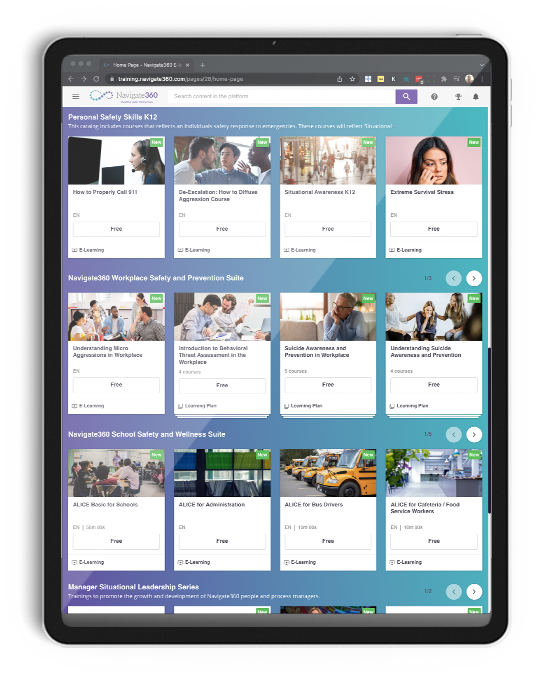
The ALICE eLearning course is interactive and on-demand to fit into any educator’s busy schedule and provides a certificate upon successful completion to ensure comprehension. The course foundational information on the following awareness & communication strategies: Situational Awareness, Alert and Inform, and these response options: Evacuate, Enhanced Lockdown and Counter.
- Save lives with age- and ability-appropriate active shooter response training using a trauma-informed approach
- Mitigate risk with documentation that ensures everyone in your school is prepared and empowered with research-supported training
- Build confidence in your students and staff with training they can use anytime and anywhere they become unwilling participants in acts of violence
- Flexible and configurable with role-specific courses for Administrators, Coaches, Food Service and Cafeteria Staff, Educators, Bus Drivers and Support Staff
- Continued support and knowledge checks to reinforce learning
Continue In-Person
The hands-on training portion of ALICE is imperative for quick and fluid recall of the strategies in an emergency. Whether you choose to have an internal ALICE Certified Instructor (ACI) in your school building or leverage your local ACI first responder to provide the hands-on portion, it is critical that your staff and students participate in the interactive training to increase their ability to remember these strategies when they need them most.
- A blended approach that combines eLearning with instructor-led training is recommended by the Department of Education for maximum retention and effectiveness
- Trained safety experts steeped in the program provide the information you need when you need it
- Understanding and practicing the response options ensure you and your entire school community knows what to do no matter where they are in the school
- Twenty years of lessons learned put to work for your school to increase the chances of survival in active threat incidents
9 out of 10 students reported feeling prepared and confident after taking ALICE Active Shooter Response Training.
A Perfect Fit for You
Training Based on Age & Ability
ALICE Training® is delivered in an age- and ability-appropriate way. The K-12 curriculum has been customized to children’s age as well as cognitive, behavioral and developmental ability levels. Robust resources for all educators are available in each lesson, including resources for students with special considerations.
Lesson Plans for Grades K – 3rd, 4th – 8th and 9th – 12th
- Lessons are structured appropriately for the cognitive level of younger students, and for grades four and later, Stop-and-Do activities are facilitated by a teacher in the familiar surroundings of the classroom
- This model provides age-appropriate training to minimize the anxiety of preparing for active shooter response while helping to develop decision-making skills students can use during a real threat


Resources for Students with Special Considerations
- Design Guides provide a customizable template to help educators develop a plan for each student
- Social Stories offer a customizable template to help educators talk to students about lockdown and evacuation
- ALICE power cards are used to help students visualize the steps to the drills
Why and How ALICE Training® Works to Save the Lives of Students and Staff
Frequently Asked Questions
Want to learn more about ALICE Training®?
You have questions about ALICE Training®, and we have answers! Use our frequently asked questions to help you find the answers you need to help you determine if ALICE Training® is right for your schools.
If you don’t find the answer you need, please use the button below to contact us.

What will be the time commitment for the training and implementation?
ALICE Training® has transitioned from a pure instructor-led model of training that could take years to fully implement organization-wide to a blended model of eLearning and instructor-led training that can be done in a matter of weeks. Individuals will be trained with the classroom/theory portion being conducted via ALICE’s web training portal, then that training is furthered by an ALICE Certified Instructor conducting hands-on demonstrations, drills and scenarios. In just a matter of weeks, the organization can become an ALICE Certified Organization. Nothing is as important as your schools’ safety and security.
What is the difference between “Fight” and “Counter,” or is it just semantics in word choice?
There is a difference, and it is not just semantics. ALICE Active Shooter Response Training does not teach fighting skills. Competing recommendations do emphasize skills and techniques that would be considered “fighting,” such as gun take-away, striking techniques and pain compliance. “Fighting” skills take a lot of time and practice to become proficient in them. ALICE teaches the skills needed to “Counter” an attacker’s ability to shoot accurately. We teach the use of noise, movement, distance and distractions to make shooting accurately very difficult, and if appropriate, we teach a swarm technique to take back control as a last resort. All recommendations and training are conducted at age- and ability-appropriate levels.
Will we be held liable for decisions we make during the event, personally or as an organization, for using ALICE Training®?
While no one can guarantee a lawsuit will not follow any critical incident, the strong defense of following “best practices” and “standard-of-care” that is called for by our federal and state guidelines is what a reasonable court/jury would expect. It certainly puts us in a better position of defense than if we were NOT aligning with those recommendations.
Has an ALICE-trained organization ever been tested and has ALICE made a difference in the outcome?
Yes, ALICE-trained institutions have had several situations where some part(s) of ALICE Training® protocols were incorporated and the outcome was deemed by those involved in the event as positive due to their training.
Why the ALICE Training® program?
ALICE Training® was the pioneer in active shooter preparation training in our country. It was the first program to question the reasonableness of “lockdown-only” policies and training. Because ALICE was first, it has the most experience, credibility and support for program implementation.
GUIDE
The Ultimate Guide to ALICE Training® for Schools
Discover how the ALICE research-based active shooter response program empowers students and staff to respond and survive in the face of violence.

Additional Resources

Violence Can Happen Anywhere, at Any Time
Understand why violent incidents are taking place in today’s society, including public spaces. Be prepared – download this eBook today.
Download Now
The Importance of a Trauma-Informed Approach to Safety Training in Schools
A trauma-informed approach is guided by the concept of the “Four R’s.” This stands for Realize, Recognize, Respond and Resist re-traumatization.
Learn More
Kraig Hissong Talks about How ALICE Training® Saves Lives
Don't miss this riveting testimonial video about ALICE Training® in which Kraig Hissong, superintendent of the West Liberty-Salem School District, shares his story about how ALICE saved lives.
Learn MoreRelated Products and Services
Customers Who Purchased ALICE Active Shooter Response Training Also Purchased These Products/Services
At Navigate360, we believe that by bringing a comprehensive safety solution into your organization, you strengthen your ability to keep those you serve safe. Here are some key products that work exceptionally well when paired with ALICE Active Shooter Response Training.

Emergency Management Suite
Navigate360’s Emergency Management Suite simplifies safety preparedness and compliance and puts you in control of keeping students and staff safe during drills, on-campus incidents and reunification and recovery.
Behavioral Threat & Suicide Case Management
Our evidence-based behavioral risk management software provides a consistent process for evaluating incidents early, enhancing threat prevention, and improving positive outcomes for students of concern.
Learn More About Behavioral Threat & Suicide Case Management
School Risk Assessment
You can’t build a true culture of safety without knowing all of your risks.
Contact Navigate360
Request a Demo of ALICE Active Shooter Response Training
Discover how you can use ALICE Active Shooter Response Training to improve school violence prevention and awareness. Speak with one of our Safety Specialists today.