
Alyssa’s Law
Understanding Alyssa’s Law: Panic Button Solutions for Schools
Alyssa’s Law is legislation designed to address critical gaps in school security emergency response by requiring the installation of silent panic alarms that directly alert law enforcement and 911 dispatch. Initially passed in New Jersey, Florida, and Texas, the law is gaining momentum at the federal level as more states recognize the need for rapid communication during emergencies in public schools.

The Origins of Alyssa’s Law
Alyssa’s Law is named in honor of Alyssa Alhadeff, a 14-year-old student who tragically lost her life during the 2018 shooting at Marjory Stoneman Douglas High School in Parkland, Florida. The law stands as a powerful call to action, with a clear goal: to reduce law enforcement response time and improve communication in school emergencies.
By requiring the implementation of panic alarm systems in schools that alert Public Safety Answering Points (PSAPs), Alyssa’s Law is shaping the future of school safety, embedding rapid response technology into the foundation of school safety plans nationwide. Central to Alyssa’s Law is ensuring alerts reach dispatch directly and instantly—without internal routing delays—to give first responders the information they need to triage victims and save lives.
Where is Alyssa’s Law Being Put Into Action?
Alyssa’s Law is gaining nationwide momentum, with Florida, Georgia, New Jersey, New York, Oregon, Tennessee, Texas, and Washington among the states that have enacted it. Additional states have recently passed the law, and legislation continues to be introduced and considered at both state and federal levels.
Arizona
Arkansas
In Process.
Learn more about HB 1492.
Florida
Passed 6/30/2020.
The bill was signed by Governor Ron DeSantis in 2020 and is already in effect.
Illinois
Passed.
Learn more about HB 5107.
Kentucky
In Process.
Learn more about HB 14.
Maine
In Process.
Learn more about LD 808.
Massachusetts
In Process.
Learn more about HB 3881.
Missouri
In Process.
Learn more about SB 781.
Nebraska
In Process.
Legislation was introduced by Senator Tony Vargas in 2020. The bill is currently awaiting approval by the Education Committee.
New Jersey
Passed 2/6/2019.
The bill was signed by Governor Phil Murphy in 2019 and is already in effect.
New York
Passed 6/23/22.
The bill was signed by Governor Hochul in June 2022 and requires all schools to consider installing silent panic alarms.
Ohio
In Process.
Learn more about SB 313.
Oregon
Passed 5/28/25.
Learn more about HB 3101,HB 3083, and the Wireless Panic Alarm Grant in Oregon.
Pennsylvania
In Process.
Senators Art Haywood and Tracy Pennycuick plan to introduce the legislation in 2024.
South Carolina
In Process.
Learn more about HB 3258.
Tennessee
Passed 5/10/23.
The bill was signed by Governor Bill Lee in May 2023 and requires that as part of their security planning, schools consider including silent panic buttons.
Texas
Passed 5/5/23.
The bill was signed by Governor Abbott in June 2023 and requires public school districts and open-enrollment charter schools to put silent panic alert buttons in each classroom.
Virginia
Washington
Passed May 2025
Learn more about SB 5004.
Proposed Federal Law:
The ALYSSA Act and the Safer Schools Act of 2021
Both the ALYSSA Act and the Safer Schools Act of 2021 are currently in committee in Congress. Introduced by Rep. Josh Gottheimer (D-NJ-5) and Rep. Roger Williams (R-TX-25), respectively, the bills would require schools to install silent panic buttons as well as conduct robust security and risk assessments to identify gaps in hard security and make necessary changes.
One Press. One System. One Coordinated Response.
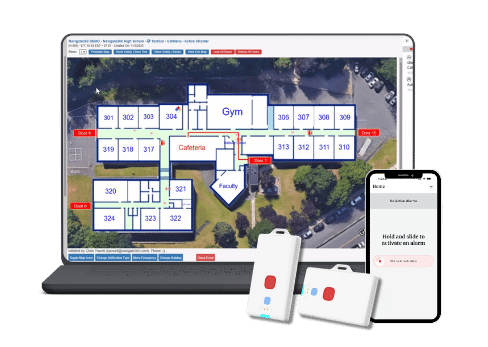
To comply with Alyssa’s Law, schools must deploy panic button solutions that allow staff to silently request help with a single action, from anywhere on campus.
Navigate360 supports Alyssa’s Law compliance through panic button technology designed specifically for school environments, ensuring alerts are delivered quickly, quietly, and with precise location information.
A compliant solution must perform under pressure, delivering reliable communication when seconds matter most.
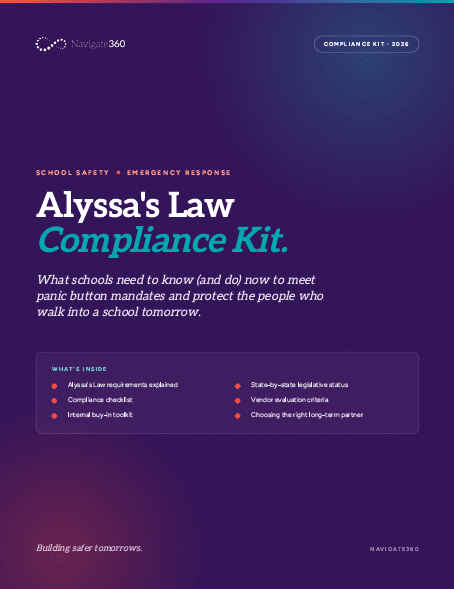
The Alyssa’s Law Compliance Kit
What schools need to know—and do—now to meet panic button mandates and protect the people who walk into a school tomorrow.
Why Our Ecosystem Approach Works
Emergency Management simplifies safety planning and makes preparedness achievable for today’s busy school environments. In the midst of a crisis, it provides full accountability—empowering staff to bring structure to chaos and make critical decisions with confidence.
With an ecosystem approach that unites preparation (e.g., drills), response (e.g., panic buttons), and recovery (e.g., reunification) into a single platform, schools can stop relying on fragmented solutions.
The result? Less panic, faster action, and better protection for students and staff. For a principal facing a lockdown, it’s the difference between scrambling across disconnected tools and having everything—alerts, maps, headcounts—readily available in one place.
Navigate360 Emergency Management Platform:
- Simplifies emergency planning with intuitive tools and templates
- Streamlines drill management, documentation, and compliance tracking
- Empowers staff with real-time alerting and coordination tools
- Provides structured reunification and recovery workflows
- Delivers real-time roll call and accountability data to support emergency triage
Navigate360 equips schools with connected tools that reduce confusion, speed up response, and ensure nothing is left to chance. Learn more about connected emergency response.
Built for Everyday Incidents, Too
While Alyssa’s Law was created in response to school shootings, panic buttons are used far more often for everyday incidents that still require immediate support. Staff regularly use panic alert tools to respond to:
- Medical emergencies
- Mental health crises
- Fights and student altercations
- Staff safety concerns
Panic buttons are a critical tool for daily school operations, not just worst-case scenarios.
Empowering Schools to Respond in Seconds: How Panic Buttons Can Save Lives
Watch this on-demand webinar from Navigate360 featuring national school safety advocate Lori Alhadeff—founder of Make Our Schools Safe—and Derek Norman, Transportation & CTE Director at Gibson County Special School District, as they discuss the critical role panic buttons play in protecting students and staff when every moment matters.
Contact Navigate360
Ensure Alyssa’s Law Compliance
Ready to meet Alyssa’s Law requirements and create a safer environment for your students and staff?
Schedule a conversation with a Navigate360 safety specialist to explore how our panic button and Emergency Management solutions can support compliance and help protect your schools.