The latest national data on student mental health brings encouraging news—and a clear reason to keep support a priority.
The Youth Risk Behavior Survey 2025 found improvements in five measures of mental health and suicide risk among U.S. high school students compared to 2023. Yet, about one in three students still reported persistent feelings of sadness or hopelessness.
For school leaders, these findings raise a practical question: How can schools build on progress while reaching students who continue to struggle?
The CDC’s Youth Health in Focus: Findings From the National Youth Risk Behavior Survey 2015–2025 offers a starting point. Its findings reinforce the need for safe school environments, trusted relationships, and clear pathways from recognizing a concern to providing support.
What Does the Youth Risk Behavior Survey 2025 Show?
The Centers for Disease Control and Prevention (CDC) conducts the Youth Risk Behavior Survey every two years. Its national survey provides a representative picture of health behaviors and experiences among U.S. high school students.
In 2025, a smaller percentage of students reported each of the following experiences than in 2023:
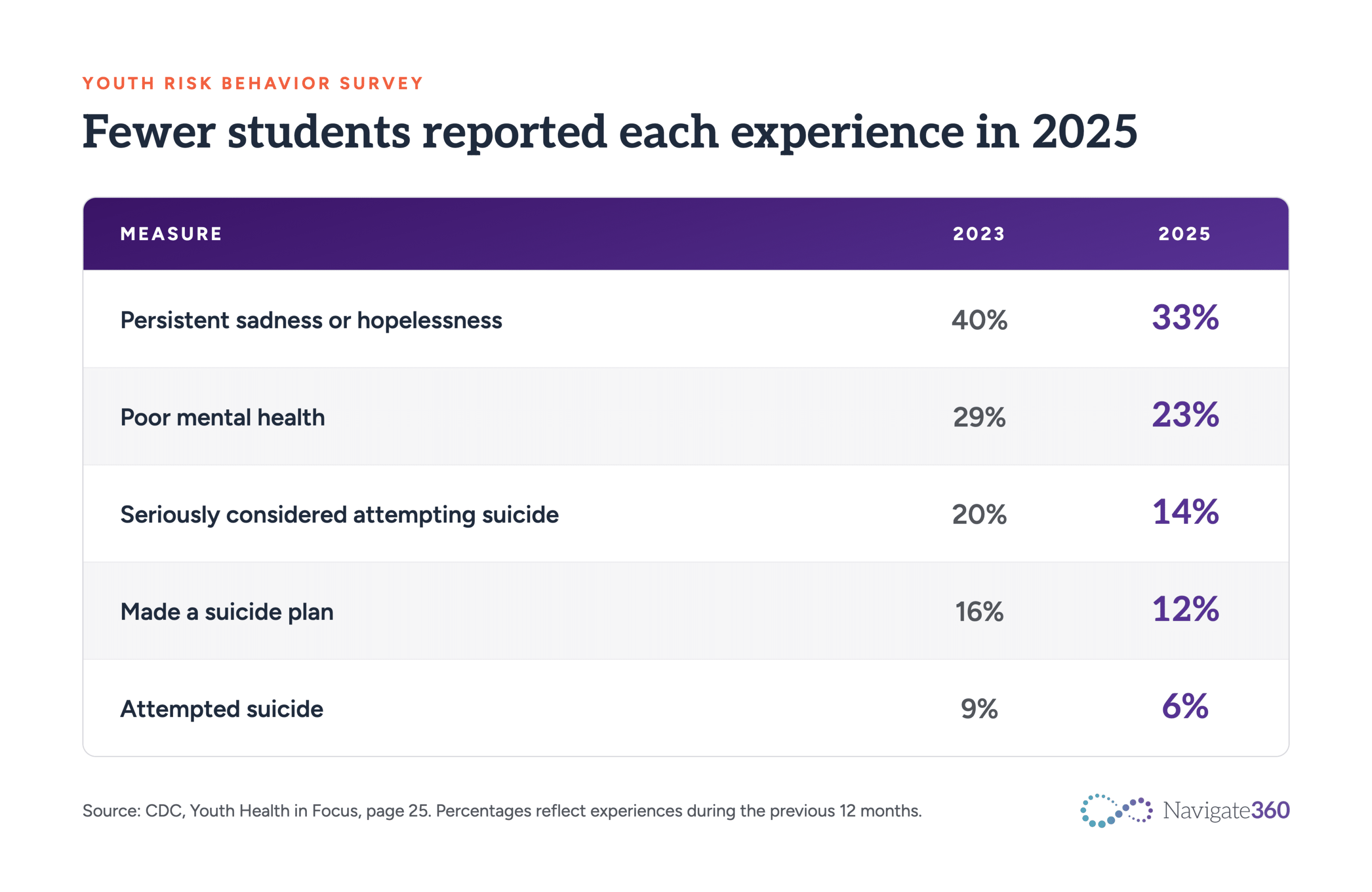
These improvements matter. They also require context. Feelings of persistent sadness or hopelessness remained above the 30% reported in 2015. Schools still face a substantial need for student support.
A Closer Look Reveals Different Student Needs
The survey also examines differences within the national results. Looking at these patterns can help schools consider who may need additional outreach and when support should begin. Students’ circumstances vary, so their needs cannot be understood through an overall percentage alone.
Among female high school students, 43% reported persistent sadness or hopelessness, compared with 24% of male students. Female students were more likely to report each of the six mental health and suicide-risk indicators measured.
Grade-level differences also matter. Ninth graders were more likely than 12th graders to report making a suicide plan and more likely than 11th and 12th graders to report attempting suicide.
For schools, these findings reinforce the importance of support during the transition into high school. Students need to know which adults they can approach, how to ask for help, and what happens after they share a concern.
A multidisciplinary team can bring together perspectives from counselors, teachers, administrators, and other relevant staff to understand individual concerns and coordinate support. These broader patterns can inform outreach, while each student’s needs guide the response.
Digital Well-Being Belongs in the Conversation
Student experiences extend into digital spaces. In 2025, 36% of high school students reported using social media every hour or more—a measure that did not change significantly from 2023.
Frequent use alone does not establish that social media causes mental health challenges. However, the report recognizes that digital behaviors can influence sleep, safety, and mental well-being.
Schools can help students develop the skills to navigate technology safely. The CDC highlights teaching students to recognize harmful content, identify trustworthy information, protect their privacy, and manage screen time.
Partnering with families can reinforce these habits. Opportunities for in-person connection, including clubs, activities, and device-free spaces, also belong in a comprehensive approach to student well-being.
Turn the Findings into Everyday Support
The Youth Risk Behavior Survey 2025 gives schools a clearer picture of student needs. The next step is connecting that information to daily practice.
Strengthen relationships before concerns emerge.
The CDC recommends increasing connectedness with peers and teachers. Schools can create regular opportunities for students to build relationships with caring adults and feel part of their school community.
Teach skills students can use.
Mental health literacy, coping strategies, and problem-solving skills help students understand challenges and recognize when they need support.
Navigate360 Compass Curriculum can help schools incorporate these skills into everyday learning through lessons focused on student well-being.
Prepare staff to take the next step.
Recognizing a warning sign is only the beginning. Staff need training to identify suicide-risk behaviors and make appropriate referrals. Clear procedures help them understand whom to contact and how to move a concern forward.
Connect recognition with follow-through.
Schools also play a role in linking students to mental health services. A coordinated approach helps teams document concerns, determine next steps, and follow up on support.
Behavioral Case Manager helps teams document concerns, assessments, interventions, and follow-up. When a concern involves potential violence, Behavioral Threat Assessment Training prepares teams to assess the situation and determine appropriate next steps.
Where does your school stand?
Are staff recognizing changes in behavior, attendance, and engagement—or waiting for students to ask for help? Is there a consistent process for responding to concerns? And who checks whether students received support and whether it is helping?
Reviewing these questions with your team can reveal where your approach needs strengthening.
Build on Progress with a Connected Approach
Encouraging national trends are a reason to keep moving forward. Make sure your school has the programs, resources, and relationships to recognize concerns early, respond consistently, and follow through with support.
Our updated A Leader’s Guide to Supporting Youth Mental Health in K–12 explores the latest findings and how curriculum, technology, and training can help your team put them into practice.
Download the guide to evaluate your current approach and identify your next step toward stronger student support.