Forty-six percent of school administrators have experienced a suicide attempt or death at their school in the past five years. That’s nearly half. Almost every other administrator.
Among students, nearly 1 in 10 attempted suicide last year, and about 4 in 10 report persistent sadness or hopelessness.
That data is staggering. And although easily overlooked, the warning signs are often hidden in plain sight.
This is the urgency that drove school leaders and mental health professionals from across the country to join Navigate360 for Hidden in Plain Sight: The Warning Signs in Words, Devices, and Student Behavior webinar on World Suicide Prevention Day.
Dr. Scott Poland, Professor and Director of the Suicide and Violence Prevention Office at NSU Florida, Jess Campbell, Senior Analytical Linguist at Navigate360, and Ryan Sladek, former educator and Regional VP of Sales at Navigate360, revealed where the warning signs are hiding, why schools may miss them, and what must happen after a concern is identified.
Ask the Question Others Are Afraid to Ask
For Dr. Poland, student suicide prevention is deeply personal.
He was 25 when his father died by suicide. At the time, he didn’t recognize the warning signs and wasn’t equipped with the knowledge to ask the right questions.
“I just wished I’d known enough to directly ask him,” he told attendees.
It was this experience that helped shape more than four decades of work in suicide prevention, intervention, and postvention. His guidance to schools is direct: if you are concerned about a student, ask them directly about suicide.
Questions to ask students may include:
- Are you thinking about suicide today?
- Have you attempted suicide before?
- Have you thought about how you would end your life?
Talking about suicide does not plant the idea but rather gives a young person an opportunity to say what they are experiencing and learn that help is available. A school-based screening can help determine whether a student needs immediate supervision and referral and help schools gather a baseline of student mental and behavioral health.
However, it is not a substitute for an assessment by a mental health professional trained in suicide risk assessment and management.
Dr. Poland also stressed the importance of limiting access to lethal means, calling it “arguably the most powerful tool we have to keep someone alive.”
Do Not Dismiss a Change in Behavior
Some warning signs are explicit: researching suicide, talking or writing about suicide, or giving away prized possessions.
Others can be easier to dismiss as stress, adolescence, or simply a bad week. A student may stop spending time with friends. They may withdraw from an activity they once loved. They may become persistently hostile, agitated, or irritable. Their sleep, attendance, or academic performance may change.
“We’ve got to be alert to significant behavioral changes in young people,” Dr. Poland said.
The key is to look for changes that are persistent, pervasive, and affecting multiple areas of a student’s life.
Schools must also consider the bigger picture. Bullying, substance abuse, self-injury, unmet basic needs, social rejection, and previous trauma are among the risk factors that can increase concern. No single event causes suicide, but each may indicate that a young person needs support.
Protective factors matter, too. One of the most important is having a trusted relationship. Dr. Poland encourages every family to ask their child: Who is your go-to trusted adult at school?
Every student should be able to name someone they would approach if they or a friend were at risk of suicide.
Know What Students Are Really Saying Online
Not every warning sign will be visible in the classroom.
According to Campbell, school-issued devices have become full-scale communication platforms. Students use documents, emails, and chats throughout the school day—and late into the night.
Within those conversations, warning signs can surface before a student’s grades, attendance, or outward behavior change. But students do not always use language adults or traditional filters recognize.
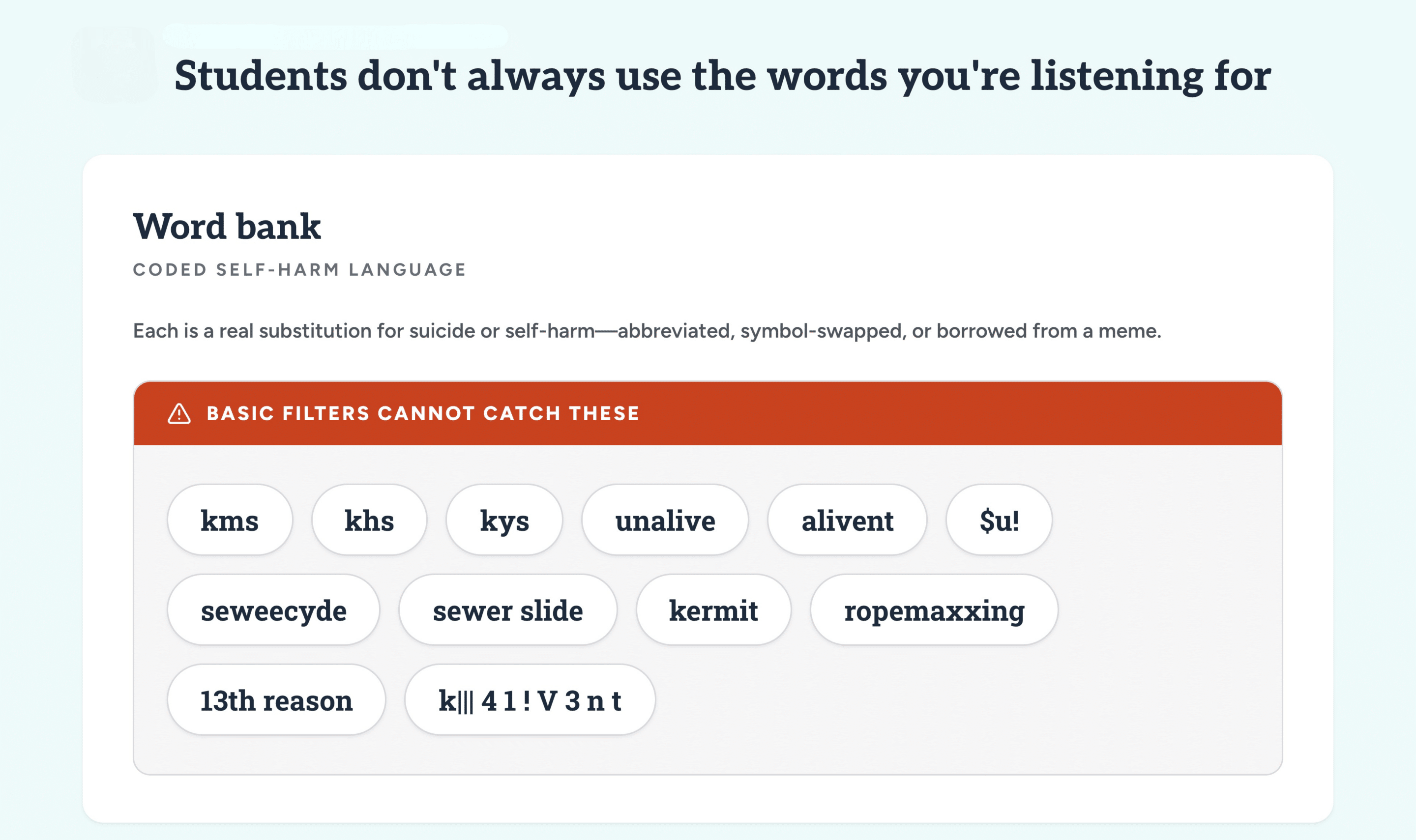
Campbell shared examples such as “unalive,” “SUI,” “sewer slide,” “my thirteenth reason,” and altered spellings created with numbers, symbols and emojis. Some phrases emerge from rapidly changing social media trends. Others are intentionally designed to evade detection.
Because this language changes constantly, a static keyword list is not enough.
Context also matters. A student may use a phrase as a joke, an exaggeration, a coping mechanism, or a genuine cry for help. Schools cannot determine which one it is without following up.
“You need to hear from the student what they actually meant by it,” Campbell explained.
Technology can surface a signal, particularly for students whose other warning signs may go unnoticed. But it should never replace professional judgment. It should create another opportunity for a trained adult to ask questions and connect a student with help.
Here are some example of code words students may be using to hide suicidal intent:
A Warning Sign Is Only as Valuable as the Response
Recognizing a warning sign is not the finish line. The most important question is: What happens next?
Dr. Poland recommended annual suicide prevention training for everyone who interacts with students, not one-time professional development that staff may struggle to remember years later. Evidence-based training can help employees recognize warning signs, respond appropriately, and refer a student for qualified support.
A consistent school district process should define how teams will:
- Provide immediate adult supervision when necessary
- Conduct an initial screening with a validated tool
- Notify a parent or guardian
- Refer the student to a qualified mental health provider
- Develop and share a written safety plan
- Document actions and assign follow-up responsibilities
- Coordinate the student’s return after hospitalization
Sladek demonstrated how Navigate360 Digital Threat Detection and Behavioral Case Manager can connect those steps. A concerning alert can become a documented suicide risk screening, guardian notification, safety plan and coordinated set of interventions.
That shared visibility is critical. A student’s care should never depend on one person holding all the information.
“Consistency equals fidelity,” Sladek said. “Fidelity decreases liability.”
Schools should also review applicable guidance from their state’s department of education and department of health when evaluating prevention programs, training requirements, and response protocols.
If you or someone you know is in immediate danger, call 911. In the United States, call or text 988 to reach the Suicide & Crisis Lifeline.
Don’t Wait for a Crisis to Plan
Students may reveal what they are experiencing long before they ask for help directly. The right knowledge can help your team recognize those signals, act sooner, and prevent suicide.
Watch the webinar on demand to hear Dr. Scott Poland, Jess Campbell, and Ryan Sladek break down where warning signs hide, what they may sound like and how schools should respond.