The path to a student crisis is rarely defined by one moment. A student’s experience is often not as straightforward as it may seem from the outside.
Sometimes, after a tragedy, we can look back and see signs that seemed insignificant at the time. A student who was withdrawing may have seemed to be having a rough few weeks. A change in grades may have had a perfectly logical explanation. A teacher, counselor, parent, or friend may have seen one piece of the story without knowing what was happening elsewhere.
That’s one of the challenges of suicide and school violence prevention– the signals that become meaningful later are not always recognizable in the moment, and the context surrounding them may be spread across different people and places. The problem isn’t necessarily that no one was paying attention; sometimes, it’s that no singular person was holding the whole picture, because no single person ever can.
We can’t expect one person to recognize every signal. But we can create more opportunities for those pieces of information to come together while there is still time to do something about them.
For school leaders working to connect the signals and support students, this blog explores spotting at-risk students before a crisis starts by bringing information and warning signs together—and using technology and training to support early intervention.
Schools Have a Unique View
Schools are uniquely positioned for early intervention because so much information about a student naturally passes through them.
Students communicate digitally on school-owned devices. They make anonymous reports through tip lines. Teachers and staff report concerns. Behavioral incidents are documented. Attendance and grades change. Counselors conduct mental health check-ins.
Schools may be one of the few places where so many of those pieces can be seen within the same institution, by people who are in a position to do something about them.
In an ideal world, a student doesn’t first get noticed once they’ve reached a major crisis point… they’re noticed much earlier.
Someone sees the puzzle pieces, puts them together, and pulls the student aside before things escalate.
What Type of Information Can Help Schools Identify At-Risk Students?
There is no singular profile that tells us which students are going to become dangerous to themselves or others. There is no checklist of traits or behaviors that can reliably identify a future outcome in advance.
Suicide and youth violence are complex, multifactorial problems. The CDC emphasizes that neither is generally caused by a single factor. Instead, risk and protective factors can exist across an individual’s circumstances, relationships, community, and broader environment.
It can be useful to think about the risk assessment data in four broad categories:
🔴 Warning Signs are the signals you would be most likely to check on first. They are observable behaviors or communications that may indicate a student is experiencing significant distress or moving closer to a potential crisis.
🟠 Current Stressors are circumstances that can add pressure in the present. They may be temporary, but they can compound what a student is already experiencing.
🟡 Risk Factors are underlying experiences or conditions that may make a student more vulnerable to stress and distress over time. These can accumulate and interact with current stressors.
🟢 Protective Factors are the supportive relationships, connection, coping skills, access to care, and other factors that can help a student navigate challenges. While these factors can help mitigate the challenges, they don’t necessarily balance them out.
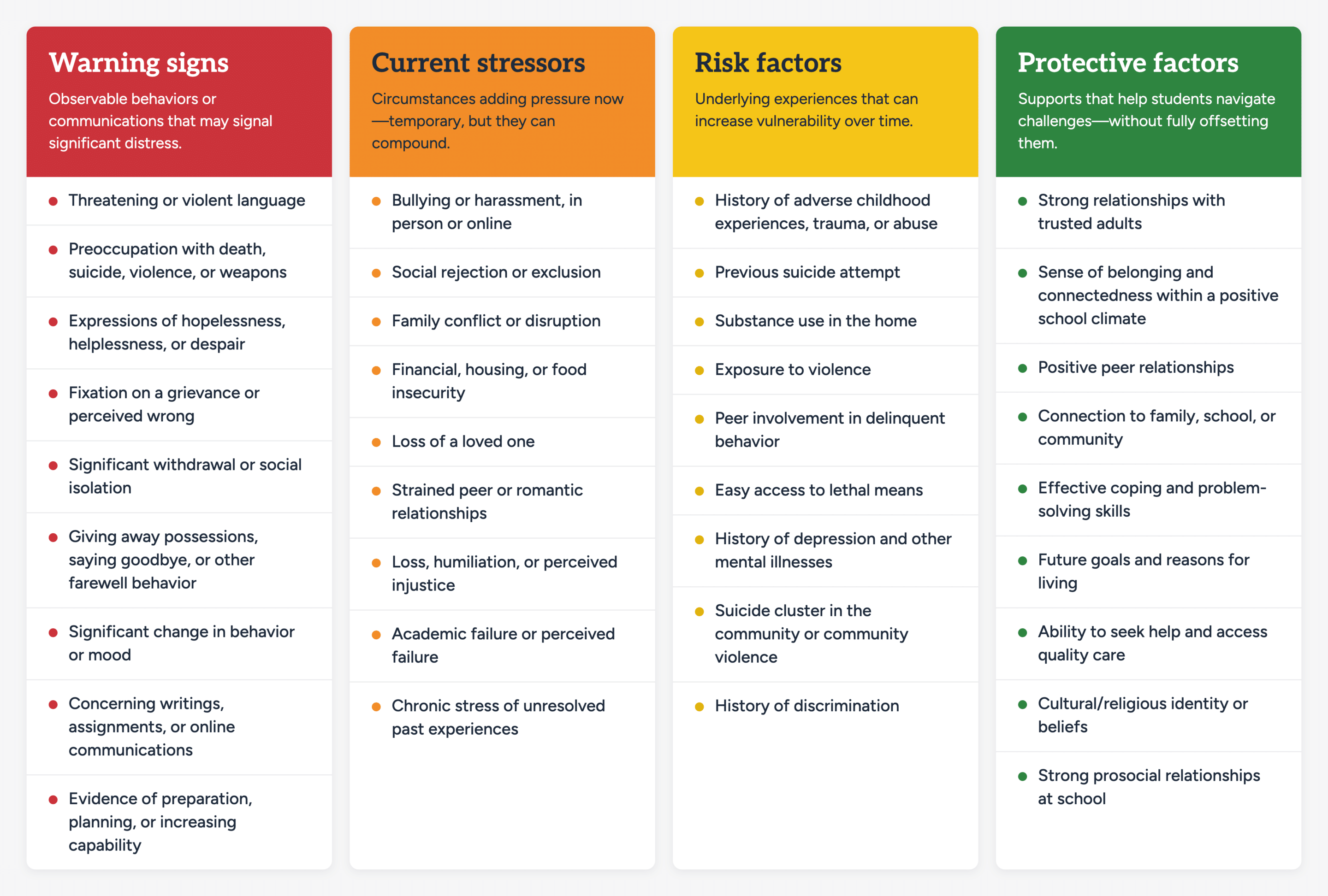
It’s mix and match.
No two students will have the same circumstances, and there is no magic number of check marks across these columns that can predict when a student will harm themselves or someone else.
But an accumulation of signals can be enough of a reason to act.
They help you assess what’s going on with the student in greater context, support them proactively, and manage concerning behaviors before they reach a crisis point requiring emergency response.
Connecting the Signals
The best way to see the picture forming is to house all of this information in a way that makes it easy to see the connections between the pieces.
A student might show leakage through digital signals, be the subject of an anonymous report, have a behavioral concern documented by a teacher, or have a counselor learn more about stressors or risk factors. Attendance patterns, like chronic absenteeism, can also prompt questions about what a student is experiencing. Each piece offers a starting point for a conversation—not a conclusion about the student.
The information may all exist. The challenge is being able to bring it together.
That’s where a connected approach can help.
With an in-suite approach like Navigate360, schools can bring these different pieces of the picture into a connected workflow, making it easier to review concerns, follow up, and coordinate student support.
The technology won’t tell you what the picture means. It will never, and should never, replace the people who know the student or the professional judgment and training required to understand context and support at-risk students.
What it does do is help make the right information easier to see together, in one place, so you can notice patterns, recognize that a student may need support, and give someone the opportunity to ask a student, “Are you okay?”
See What Happens When the Signals Come Together
Behavior is a school safety issue. When school districts can see the signals and pull together a complete picture of a student, they can work to get the right level of support for that student and prevent violence before it starts.
One real world example: Danville Public Schools. Here’s how Director of Safety and Security Jeff McLaughlin described their process before Navigate360: “Under our previous platform, it made the threat assessment teams feel like they were getting ready to go into the abyss to help a student.”
After they adopted Navigate360 Behavioral Case Manager and Digital Threat Detection, the district gained a new layer of visibility. The two tools pulled together the information Jeff’s team needed to identify students who needed help before a concern could escalate into a crisis.
“A student needs to know that the adults in the room see them,” Jeff said. “And this right here shows that we see them…It has saved lives.”
See what’s possible for your district when your systems are fully connected.