Healing after a mass shooting does not end when the news cameras leave.
An estimated 28% of people who witness a mass shooting develop post-traumatic stress disorder, and about a third develop acute stress disorder, according to the National Center for PTSD.
Weeks after a former student opened fire in her classroom, Missy Dodds asked another survivor’s spouse how long it would take to feel normal again: “I don’t think this is something that you’re going to get over,” he told her.
That moment, when the media moves on and everyone else returns to routine, is where recovery truly begins.
That is the reality that brought educators, safety leaders, and mental health professionals together for After the Headlines: Prevention, Recovery, and the Journey Forward, a webinar from Navigate360 and Safe and Sound Schools.
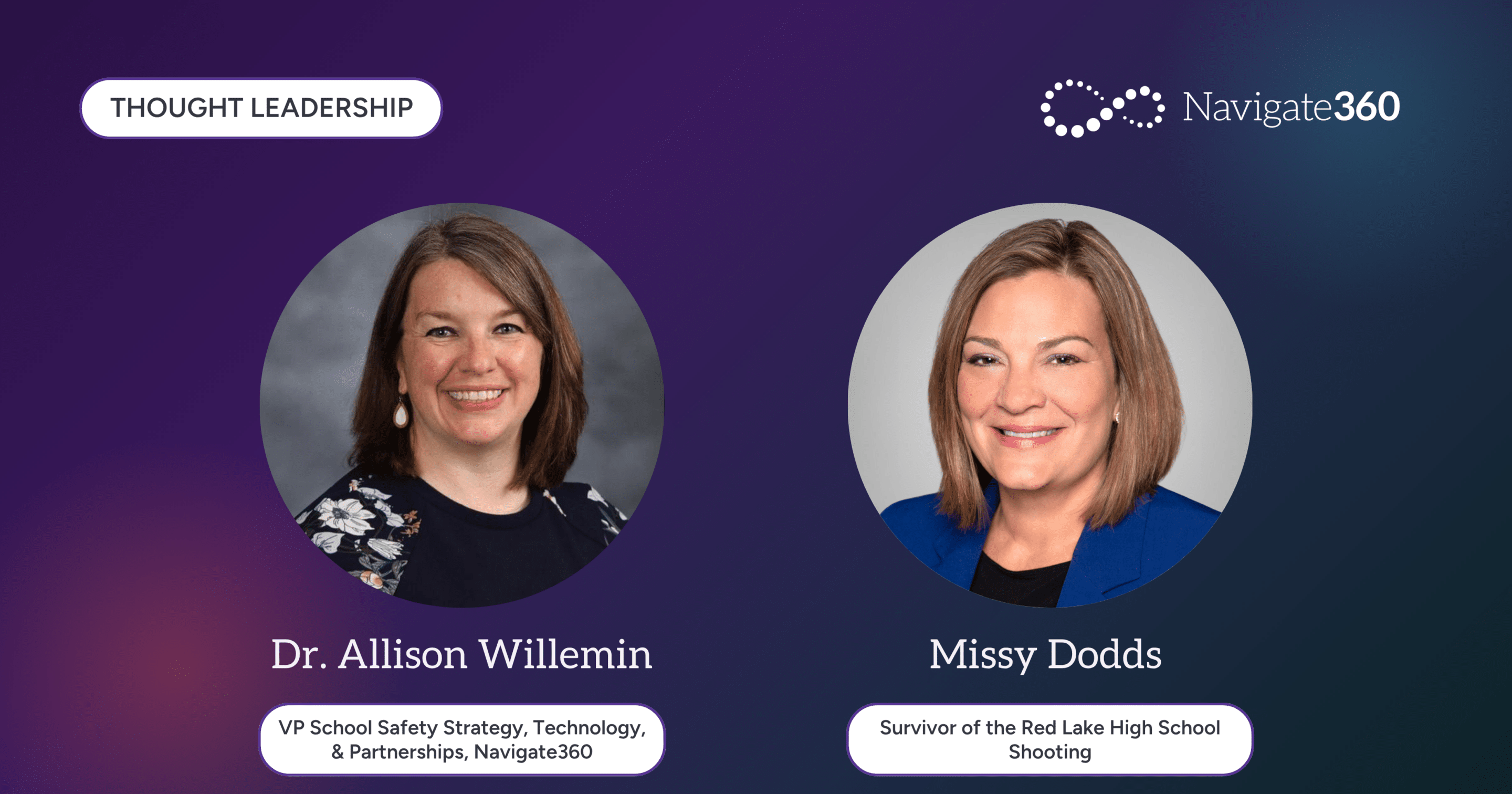
Dodds, a survivor of the 2005 Red Lake High School shooting, joined Dr. Allison Willemin, a survivor of a church and a school shooting and Vice President of School Safety Strategy, Technology, & Partnerships at Navigate360, for a conversation about what recovery looks like after a traumatic event, why reunification planning matters, and how leaders can help survivors move forward without simply “moving on.”
Recovery Starts in the First Hour
Recovery begins in the first hour. Reunification, the controlled process of reuniting displaced survivors with their families, can either ease trauma or add to it, the controlled process of reuniting displaced survivors with their families, ease trauma or add to it.
“You’re in shock, you’re numb,” Dodds said. “A person that’s just been involved doesn’t know what to do.”
At Red Lake, reunification was chaos. For Dr. Willemin and her church, reunification happened at a movie theater, where teenage employees suddenly found themselves witness to survivors and families reuniting.
Reunification doesn’t have to be chaotic. Preparation helps ensure families and communities have what they need after an event.
Basic elements schools can put into their emergency and recovery management plans today:
- Establish receiving sites in advance: you could choose churches, grocery stores, or fairgrounds
- Control the media: Establish a designated spokesperson
- Tell parents where updates will come from: these could be private or public outlets
- Prepare communication templates: in case a day comes where there’s no time to thoughtfully think through your next steps
Putting these elements into place can help children, families, and the community avoid unnecessary trauma in an already turbulent situation.
“When the unimaginable happens, it’s important to have someone who says, ‘Okay, we’re going to take control for a second,” Dodds offered.
There Is No Timeline for Healing
About six weeks after the shooting, Dodds wanted to know when she would feel like herself again. She referenced how if you break an ankle, a doctor can tell you what to expect in three to six months, but trauma is different—it doesn’t heal like a broken bone.
“When a traumatic event happens, it truly changes everything,” Dodds said. “It changes your life, your sleep patterns, your sense of security.”
According to the Cleveland Clinic, PTSD doesn’t have a quick cure, but it can be managed and feel less disruptive over time. Getting there rarely follows a straight line, and it often depends on having the right support.
For Dodds, the turning point came when she entered treatment six months after the event and someone told her it was okay to take as long as she needed. For Dr. Willemin, the setbacks came when she least expected them. A week after the church shooting, even returning her library book didn’t feel possible.
Students also heal on their own timelines, and they don’t always need what the adults in their lives expect.
For example, Dodds’ first thought after the incident was that the school should close for the rest of the year, but her students told her how much they needed to be back together—just not in the same building where it happened.
For schools, it’s important not to set a deadline for recovery. Give survivors permission to heal at their own pace, check in when support begins to fade, and ask what they need.
How Communities Can Support Survivors Long After the Storm
The impact of violent incidents reaches far beyond the people inside the building or in the place where it occurred. Dr. Willemin has seen this firsthand in Michigan, where some first responders have answered four major incidents since 2021.
Those responders are trained to handle high-intensity situations, but they are also members of the community. The people they’re helping may be their neighbors, fellow church members, or the parents of their children’s friends. As Dr. Willemin explained, what first responders have seen is something “they will carry with them every day,” even as they drop their own kids off at school.
That’s why healing has to be a community effort, and why it can’t stop when the headlines end. When communities move on too quickly, the consequences can be devastating.
“I have lost more students to the trauma of the shooting than I did that day,” Dodds shared.
She explained how many survivors try and numb their pain with alcohol or drugs, and she can trace where that path began for students she lost. Dodds advice is to give survivors grace, time, and support, long after the first weeks have passed.
So, what does that support look like?
- Widen the circle of care: offer support and mental health services to all affected, including neighbors, bystanders, and the employees at receiving sites, not just those who were at the building
- Support your first responders: Dr. Willemin noted that Michigan fire and police chiefs have built ongoing, internal support for their teams
- Give grace, but not deadlines: Some survivors return to work in two days, and others never return. Both options are okay.
- Connect survivors with each other: Dodds described time with fellow survivors as her “her heart talking to their heart.” As she put it, “You can give a hug, and you don’t have to say a word. They just know.”
Ask Survivors What They Need
Dr. Willemin warned that when leaders keep making decisions for survivors without asking, it adds more harm than it helps.
“If something happens to you, and then things keep happening to you, all you’re doing is re-traumatizing.” Dr. Willemin said.
Instead, ask survivors what they need, and listen, even if they’re not sure what they need.
The National Mass Violence Victimization Resource Center offers guidance built on that same principle.
Meaningful support does not need to be a spectacle:
- Sit with them: Presence matters more than perfect words.
- Remember the dates: A simple text on an anniversary means more than you know.
- Don’t judge the timeline: Every survivor heals differently.
For Dodds, the hardest part often comes when the rest of the world moves on. Each year on the Red Lake Day of Remembrance, the text she receives, simple hearts and prayers, still mean a lot.
“It’s really hard when the rest of the world moves on,” Dodd said. “That’s how you support people—you don’t forget.”
Build Relationships Before Tragic Events Happen
Prevention and recovery are not separate conversations. In a crisis, “you can’t think,” Dodds said. That’s why the lists, plans, and connections have to exist beforehand.
Dr. Willemin credits years of relationship building in her community with helping her respond the moment tragedy reached her own church. “I knew who to call,” she said.
To build that network, she encourages districts to:
- Get to know your emergency managers and community first responders personally
- Invite faith communities and parks and recreation to district safety meetings
- Engage youth organizations and scout troops
- Make a list of people who can simply come and sit with survivors when they’re needed
“You don’t want to meet the fire chief on the day your school’s burning down,” Dodds said.
These lessons apply long before a crisis, too.
Don’t Wait for a Crisis to Plan Reunification
Reunification is one of the first things survivors experience after a traumatic event. A practiced plan can protect families from added trauma and set the stage for healing.
Download the free Family Reunification Guide to build a trauma-informed plan your team can put into practice before a crisis occurs.
Want to hear the full conversation? Watch After the Headlines on demand.